The Ultimate Pivot: How Your Final Research Project Defines Your Professional Brand
In the competitive landscape of the modern job market, a degree is often viewed as the entry ticket. However, the “Final Research Project”—whether it’s a senior thesis, a capstone, or a doctoral dissertation—is the performance that determines your seat in the front row. For students in the United States, this project is frequently the first substantial piece of intellectual property they produce. It is not merely an academic hurdle; it is the cornerstone of a professional brand.
The Shift from Student to Subject Matter Expert (SME)
The transition from a student who consumes information to a professional who generates insights is pivotal. Employers today are looking for “Proof of Competence.” According to a report by the Association of American Colleges and Universities (AAC&U), 93% of employers agree that “a candidate’s demonstrated capacity to think critically, communicate clearly, and solve complex problems is more important than their undergraduate major.”
Your final project is the tangible evidence of these skills. When you spend months investigating a specific niche—be it the impact of blockchain on supply chain logistics or the psychological effects of remote work on Gen Z—you are effectively claiming your territory as a Subject Matter Expert.
Strategic Intellectual Positioning
Building a brand requires a unique selling proposition (USP). Your research project allows you to align your academic output with your career aspirations. For instance, a law student focusing on digital privacy laws isn’t just finishing a degree; they are branding themselves as a future privacy consultant.
Navigating these complex academic requirements requires precision and a deep understanding of methodology. Many students find that professional dissertations help is essential for refining their research questions and ensuring their final document meets the high standards of E-E-A-T (Experience, Expertise, Authoritativeness, and Trustworthiness) required in both academia and the professional world. By treating the project as a brand-building exercise, you ensure that the hundreds of hours spent in the library translate into market value.
The Skill-to-Salary Bridge: A Data-Driven Perspective
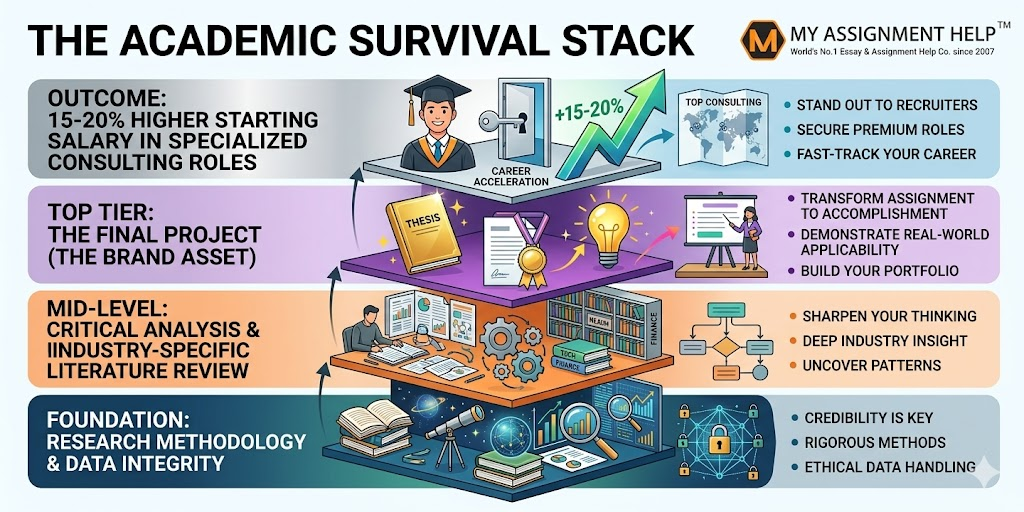
The correlation between a high-quality research project and early-career salary trajectories is becoming increasingly clear. Researching a high-demand, technical topic provides you with a vocabulary that “generalist” applicants lack.
When the workload becomes overwhelming, it is common for students to seek expert assistance to maintain their GPA and the quality of their professional portfolio. If you find yourself struggling to balance your final year responsibilities, you might choose to pay someone to do my assignment to ensure that your smaller coursework doesn’t distract you from the high-stakes branding power of your final project.
How to Leverage Your Research for Career Growth
- The LinkedIn Integration: Do not just list your degree. Create a “Featured” section on LinkedIn dedicated to your research. Upload the abstract or a link to the full paper.
- The Interview Hook: Use your research as a “Case Study” during interviews. When asked about problem-solving, narrate the challenges you faced during your data collection and how you overcame them.
- Networking Currency: Reach out to industry leaders whose work you cited. This is a “warm” networking tactic that positions you as a peer researcher rather than a job-seeker.
Ensuring E-E-A-T in Your Research
To ensure your project truly defines your brand, it must adhere to the E-E-A-T guidelines:
- Experience: Use primary data or field interviews to show hands-on involvement.
- Expertise: Quote high-authority sources and peer-reviewed journals.
- Authoritativeness: Use statistical tools (SPSS, R, Python) to back your claims.
- Trustworthiness: Properly cite all sources to avoid any hint of plagiarism.
Key Takeaways
- Project as a Portfolio: Treat your final paper as your first professional portfolio piece.
- Niche Selection: Choose a topic that reflects the industry you want to enter, not just an “easy” subject.
- Technical Authority: Mastering the tools used in your research (data analysis, legal indexing, etc.) adds “hard skills” to your resume.
- Long-term Value: A well-cited project can lead to speaking engagements or guest posting opportunities in industry journals.
FAQ Section
Q: Can I change my professional brand if my research was in a different field?
A: Yes, but you must focus on the “transferable skills” gained—such as data synthesis, project management, and high-level communication—rather than the subject matter itself.
Q: How long should my research abstract be for a professional resume?
A: Keep it to 3–4 sentences. Focus on the problem you solved, the methodology used, and the final impact or conclusion.
Q: Is it ethical to use academic support services for my project?
A: Professional guidance is a standard part of the research process. Seeking expert help for proofreading, structural editing, or complex data analysis is a strategic way to ensure your brand asset is of the highest quality.
Author Bio:
James Sterling is a Senior Content Strategist at MyAssignmentHelp. With over a decade of experience in academic consultancy and digital branding, James specializes in helping students in the US and UK translate their academic successes into professional career milestones. He holds an M.S. in Organizational Communication and is a frequent contributor to educational technology forums.
References
- Association of American Colleges and Universities (AAC&U). (2023). “The Career-Ready Graduate Report.”
- National Association of Colleges and Employers (NACE). (2024). “Job Outlook Survey: The Value of Research Skills.”
- U.S. Department of Education. (2025). “Higher Education and Work-Based Learning Outcomes.”